


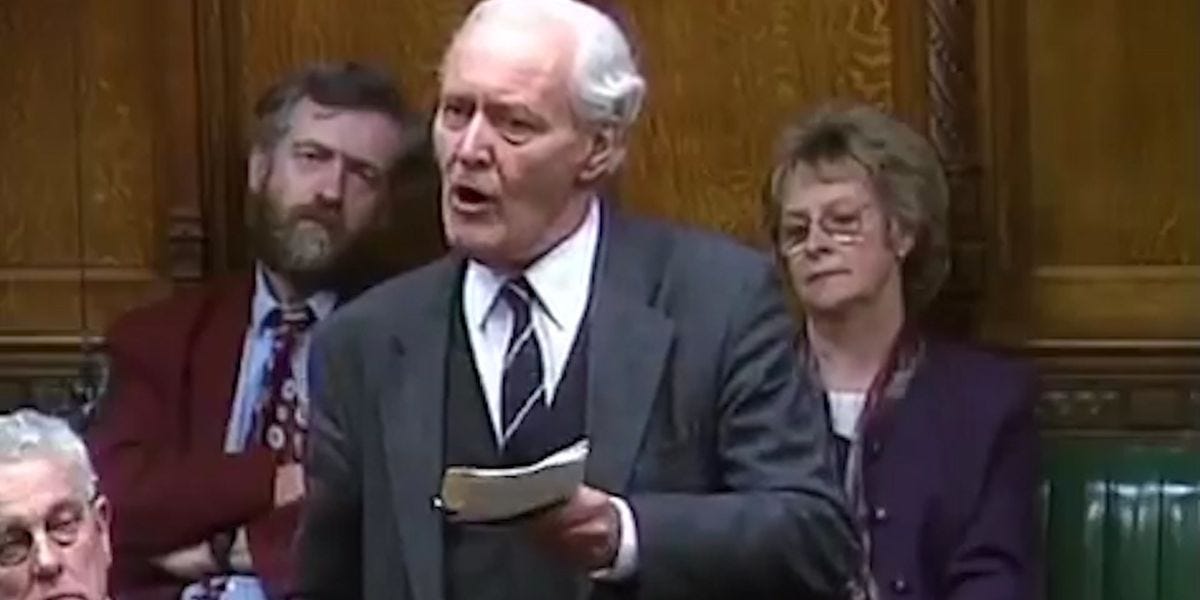
Tony Benn was the sort of man you would want as your granddad.
He was kind, funny, charming, charismatic, playful and jovial.
He was also the sort of man most would want as a politician even if they didn’t agree with every position he backed.
He was powerful as an orator. He was steadfast as a man with unshakeable beliefs and a sturdy moral compass. He was a man of privilege who gave up his privilege to stand up and fight for the common man and woman. He knew what was wrong and what was right and no promise of power or financial gain could entice him to compromise his integrity or sell out his constituents.
Born Anthony Wedgwood Benn in London in 1925, he came from a prominent political family and served in the RAF during the Second World War. He entered Parliament in 1950, aged 25. When his father died in 1960, Benn inherited the title Viscount Stansgate, which automatically disqualified him from sitting in the House of Commons. He fought a highly public campaign for the right to renounce hereditary peerages, this helping to bring about the Peerage Act 1963. He immediately gave up his title and returned to the Commons.
‘Bennism’ became a powerful and distinct current on the Labour left in the 70s and 80s, with Benn arguing that inequality and the massive concentration of wealth in a small segment of private hands was a fatal impediment to the workings of any genuine and healthy democracy.
Democratic control and accountability was also the root of his Euroscepticism. Benn held that institutions exercising political power should be accountable to the public and those occupying positions within them must be removable by voters.
He was a tireless opponent of war in all its forms (with the exception of German fascism, which he rightly saw as a fundamental threat to all civilised peoples everywhere) and campaigned passionately and powerfully against the wars on Iraq and Afghanistan.
Sadly, if Tony Benn were alive today, he would see that the barbarism, the bloodshed, and the thirst for both have only become considerably stronger.
Here is Tony Benn speaking out in opposition to war and military action against Iraq in 1998 and making the case for why he will vote against the motion and why anyone with a moral conscience should do the same.
It is among the most moving anti-war speeches of all time.
*Note to readers: Truth and Balance is a reader-supported publication. If you liked this article, consider becoming a paid subscriber.
He'll always be the best PM we never had. 🍉🏴💜
Let me comment on this if I may, since I am still struggling to articulate a position on this issue. Of course everyone with a brain cell is against war, which is the worst thing that can happen to anyone. The only thing worse than fighting a war is losing one. As a "natural" pacifist, I agree with Benn's objections to war against Iraq.
On the other hand, I'm not sure if you can make exceptions just because you want to. Explain to me again why Nazi Germany was "worse" than the Anglo-American-Zionist empire today?
But lately I've come to see things somewhat differently. What if war is the default and peace the exception? Hobbes' thought is rather profound on this point. A state of nature is a war of all against all, in which human lives are nasty, brutish and short. Then any state is better than a state of nature (no state), but the best kind of state is a civilisation state.
The trouble with a civilisation state is it can only exist as such via mutual recognition with another civilisation state. And it can only achieve such mutual recognition from a clearly defined locus of sovereignty. That clearly defined locus of sovereignty must be legitimised not only by the state-forming people (as in a nation state), but also constituent minority peoples, as well as individual citizens per se.
Next month, I'm going to be presenting a paper at a conference, which will apply these criteria to the question of whether the collective west could achieve mutual recognition as a civilisation state in its own right. You probably already know the answer to this.
In my developing view, the exceptional state of peace between civilisation states is something earnestly to be desired. But this state is far from natural. Rather, it would appear as a local phenomenon, requiring full-time work to maintain it as such. Such work can be described in terms of the strategic sincerity that would be necessary for a civilisation state to recognise – and be recognised by – another civilisation state as such.